I'd consider myself patient. I don't
mind traffic jams. I prefer to preheat the oven than use the
microwave. I'm not really big into short cuts, either. So when I hear
about learning methods which streamline learning, which make
everything easier, naturally I'm a little skeptical. It seems a
little too good to be true, doesn't it?
What I'm talking about is the idea of
a flipped classroom. A teacher uploads a video that the students view
at home, then the “homework” part is done the next day in the
classroom. What an idea. In theory, it seems wonderful. And according
to the research, it's been a success. It was successfully implemented
in a pharmacology classroom, for example. It seems like
a great idea. So why is everyone so critical about it?
When
I was little, 8 or 9, my neighbour taught my sister and I how to
knit. We didn't go right into sweaters, though. We started with
scarves. And my sister and I diligently went to Margaret's house
after school every day for two whole weeks. Wake up, school, scarves.
A year ago, inspiration struck, and I picked up some knitting
needles. Grabbed the yarn. And stared at them for a while, willing my
hands to somehow get everything started, and hoping for muscle memory
to just do its thing. It didn't happen. What did happen was a quick
YouTube instructional video search.
We'll
compare this with my first foray into organized group sports:
Ringette. The first year I tried out, I spent the better part of a
month on my knees kind of skiing myself around the rink. Slowly but
surely, I was able to stand. (I was benched a lot that first
month...) After much patience on the part of my coach and my sister,
who was also on the team, I was able to push myself along the ice.
Soon enough I was gliding! Lo and behold: I had my first game where I
didn't fall down, much to the relief of my lower body. I was not a
very good skater. Not even a little bit. But just as luck would have
it, an early growth spurt landed me in the top percentile of height
for the team, so I was great at defence. Having not done much skating
since I stopped at the age of 11, I was very much surprised when, a
few years ago, I was able to borrow a pair of skates and pick up
right where I left off. I really do believe the difference between
the two experiences – a week of knitting versus a season of skating
– is the reason I was able to pick up one but not the other.
I
feel the same way about the flipped classroom. Learning takes time. I
understand that streamlining is a very good thing. Efficiency is key.
But only when that efficiency leads to functional results. I think
it's great if you can teach your students trigonometry within one,
two nights. And teaching them to do it well?
Even better!
But
my hesitation stems from the idea that we're going to sacrifice
longevity for efficiency. What's the point of learning everything
quickly if it means forgetting it shortly thereafter? And to be
clear, I'm not saying the flipped classroom is a bad idea. Not even a
little bit. I think it would be great if it a) works, and b) lasts.
I once encountered a person, a real human being, that didn't like edges on their brownies. But some people (myself included) think the edges are the best part. Some people build houses quickly. Others take time to lay a foundation. Some speak in analogies. Others get straight to the point: Learning takes time, and brownies need edges. Longevity is more important than efficiency. And I hope that this is something that can be addressed in the upcoming pedagogical discussion.
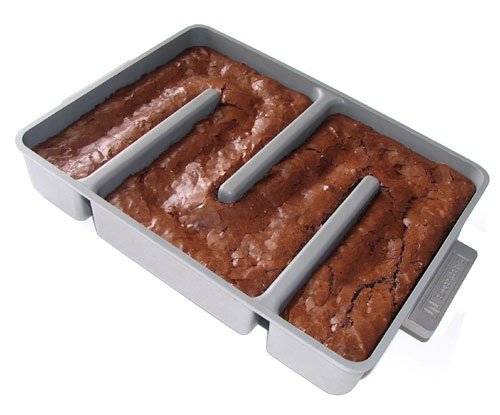 |
| A product which highlights the importance of brownie edges. Available for purchase here |

No comments:
Post a Comment